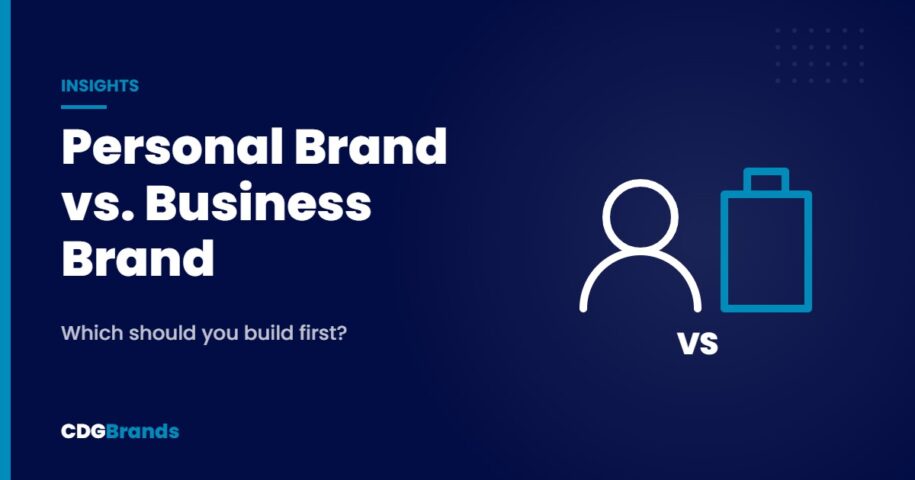
Short answer: Build your personal brand first if you are the product (consultants, coaches, creators, freelancers) or if trust in you personally drives sales. Build a business brand first if you plan to scale beyond yourself, hire a team, sell physical or digital products, or eventually sell the company. Many founders succeed with a hybrid: a business brand fronted by a visible founder.
It’s one of the most common dilemmas for entrepreneurs: should your Instagram, website and content revolve around you or around your company? The answer shapes your name, content strategy and long-term value of the business.
What is a personal brand?
A personal brand is the reputation and recognition attached to an individual: your expertise, values, story and personality. People follow, trust and buy from you. Examples include independent consultants, coaches, authors and content creators.
What is a business brand?
A business brand is the identity of a company, independent of any one person. It has its own name, visual identity, voice and promise. Customers trust the company’s products and processes rather than a single individual.
Personal brand vs. business brand: side-by-side comparison
| Factor | Personal brand | Business brand |
|---|---|---|
| Speed to build trust | Fast: people connect with people | Slower: trust builds through consistency and proof |
| Scalability | Limited by your time | Can grow with a team and systems |
| Ability to sell the business | Difficult | Easier: the brand is a transferable asset |
| Content creation | Authentic, story-driven, depends on you | Can be delegated to a team |
| Risk | Reputation tied to one person | Spread across the organization |
| Flexibility to pivot | High: your audience follows you | Lower: the brand is tied to an offer |
When to build a personal brand first
- You sell services based on your expertise (coaching, consulting, design, speaking).
- You don’t yet know exactly what product you’ll sell long term.
- Your market buys on trust and relationships.
- You enjoy being visible and creating content.
When to build a business brand first
- You plan to hire, scale or sell the company.
- You sell products (physical or digital) that should stand on their own.
- You prefer staying behind the scenes.
- You’re building in a category where institutional trust matters (finance, health, B2B software).
The hybrid approach: founder-led business brands
For most small businesses today, the strongest approach is a business brand with a visible founder. The company owns the name, identity and products; the founder shares the story, opinions and behind-the-scenes content on social media. This gives you the trust benefits of a personal brand while building an asset that can grow without you.
To make the hybrid model work:
- Define the business brand’s positioning, identity and voice first (see our brand identity checklist).
- Define how your personal voice relates to it: same values, slightly more personal tone.
- Link both consistently: your bio mentions the company; the company’s About page features you.
- Gradually introduce other team voices so the brand doesn’t depend on you alone.
A quick decision framework
Answer these three questions:
- In five years, do you want the business to run without you? If yes, prioritize the business brand.
- Do customers buy because of your personal expertise? If yes, invest in your personal brand.
- Are you comfortable being the face of the business? If not, a business brand reduces pressure on you.
Two or more answers pointing in one direction usually give you your starting point.
Get the first chapter free
Download chapter 1 of Create. Develop. Grow. and start building a brand people remember. No card needed.
Frequently asked questions
Can I turn my personal brand into a business brand later?
Yes. Many creators and consultants launch a company brand once demand outgrows their time, using their personal audience to kick-start it.
Should I use my own name as my business name?
It works well for solo service businesses. If you plan to scale or sell, a separate business name is usually more flexible. See our guide on digital branding for more on brand architecture.
Do I need separate social media accounts for both?
Not at first. Many founders start with one channel and add a company account once there’s enough content and capacity to run both well.
Is personal branding only for influencers?
No. Any professional benefits from a clear reputation, whether that’s an accountant, a developer or a shop owner.
Build the right brand from day one
Whichever route you choose, the fundamentals are the same: clear positioning, consistent identity and a voice people recognize. The Brand Builder’s Toolkit works for both personal and business brands, and the Ultimate edition includes 1-on-1 coaching to help you decide your brand architecture.
Before you go: get chapter 1 free
The first chapter of Create. Develop. Grow., the practical guide to building a brand people remember. Free, no card needed.
Leave a Reply